
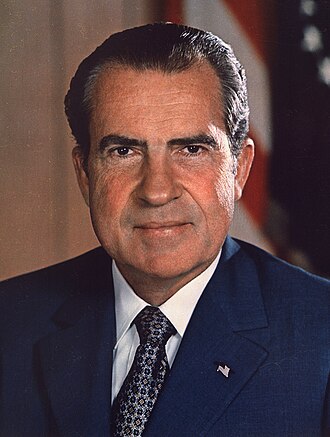
President 37 of 47
Richard Nixon
1969–1974 · Republican · California
He opened China and ended a war — then resigned over the Watergate cover-up.
- Lived
- 1913–1994
- Vice president
- Spiro Agnew; Gerald Ford
- Nickname
- Tricky Dick
- Home state
- California
“The greatest honor history can bestow is the title of peacemaker.”
The story
Richard Nixon was a Republican from California. He had been Eisenhower's vice president. He served as president from 1969 to 1974: he won in 1968 and 1972, then left in August 1974. In 1969, his first year, Apollo 11 landed American astronauts on the Moon. Neil Armstrong and Buzz Aldrin walked there in July. Nixon spoke to them by phone from the White House. In 1972 he made a historic trip that opened U.S. relations with Communist China. No American president had gone to the People's Republic of China. Opening China mattered because it pulled a huge communist country into talks with the United States. The visit changed the map of the Cold War.
In 1970 he created the Environmental Protection Agency, the EPA, to protect air, water, and land. He helped end U.S. fighting in Vietnam through the Paris Peace Accords. The 1973 accords and the end of the draft brought American troops home. The United States moved toward an all-volunteer military: young men were no longer chosen by lottery to fight. The 26th Amendment, ratified in 1971, lowered the voting age to 18 — if 18-year-olds could be drafted, many argued they should vote. Title IX, signed in 1972, opened school sports and education more fairly to girls and women.
The Watergate story began with a burglary at Democratic offices in the Watergate building. In June 1972 burglars tied to Nixon's re-election team were caught. The cover-up that followed ended the presidency. He resigned on August 9, 1974, because the Watergate cover-up made impeachment and removal almost certain. He is the only U.S. president who resigned from the office. Hiding the truth, not only the burglary, brought him down. The Saturday Night Massacre was Nixon's firing of Justice Department officials who would not kill the Watergate probe. The attorney general and his deputy refused to fire the special prosecutor, and quit. Vice President Spiro Agnew had already resigned over corruption charges of his own. Nixon named Gerald Ford to replace him. Ford then became president after Nixon resigned.
Why it matters
No one is above the law, not even a president. Watergate is how we teach that. Courts, Congress, and a free press forced the truth out. That is the system working, not breaking.
Check for understanding
20 questions from the lesson above. Misses come with a short explanation — then the lesson is yours.
Question 1 of 20
0 correct