
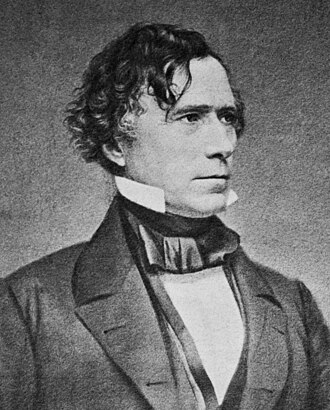
President 14 of 47
Franklin Pierce
1853–1857 · Democratic · New Hampshire
A grieving president whose Kansas policy made the slavery fight worse.
- Lived
- 1804–1869
- Vice president
- William R. King
- Nickname
- Young Hickory of the Granite Hills
- Home state
- New Hampshire
“You have summoned me in my weakness. You must sustain me by your strength.”
The story
Franklin Pierce was the fourteenth president of the United States. He served one term, from 1853 to 1857, between Fillmore and Buchanan. He was a Democrat from New Hampshire — the Granite State — and the only president from that state. People called him Young Hickory of the Granite Hills. Granite Hills points to New Hampshire; Young Hickory ties him to Jackson's Democratic line. His party did not give him another nomination in 1856.
Just before his inauguration, a family tragedy hit: his young son died in a train wreck. Pierce took office as a grieving father. He memorized it and spoke without notes — the whole inaugural address, from memory. People were impressed. His vice president was William R. King, who was ill and took the oath in Cuba. He died soon after taking the oath, in April 1853. Pierce, like Tyler and Fillmore, then had no VP. Before the White House, Pierce had been a brigadier general in the Mexican-American War.
The big law of his term was the Kansas-Nebraska Act of 1854. It let settlers vote on slavery in Kansas and Nebraska, and it repealed the old Missouri Compromise line. Pro-slavery and anti-slavery settlers rushed in and clashed. Newspapers called the fighting Bleeding Kansas. Pierce also bought a strip of land from Mexico for a southern transcontinental railroad — the Gadsden Purchase, in today's southern Arizona and New Mexico. American diplomats wrote the Ostend Manifesto, a plan about taking Cuba if Spain would not sell it. The leak embarrassed Pierce.
Why it matters
A law can look like letting people vote and still light a fuse. Kansas-Nebraska turned a map line into a fight.
Check for understanding
20 questions from the lesson above. Misses come with a short explanation — then the lesson is yours.
Question 1 of 20
0 correct