
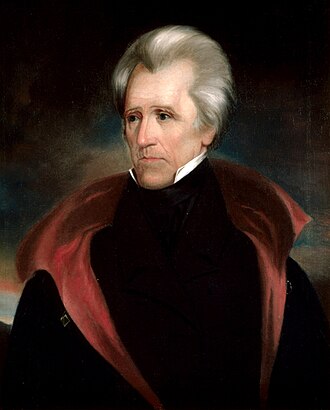
President 7 of 47
Andrew Jackson
1829–1837 · Democratic · Tennessee
A war hero who opened politics to ordinary men, killed the national bank, and stood for the Union.
- Lived
- 1767–1845
- Vice president
- John C. Calhoun; Martin Van Buren
- Nickname
- Old Hickory
- Home state
- Tennessee
“The people are the government, administering it by their agents.”
The story
Andrew Jackson was the seventh president of the United States. He was a war hero from Tennessee and the first president from west of the Appalachian Mountains. Soldiers called him Old Hickory because he was as tough as hickory wood. He became a national hero after the Battle of New Orleans in January 1815, at the end of the War of 1812. He won in 1828 and 1832 and served two terms, from 1829 to 1837.
Jackson said he spoke for ordinary people, not bankers and insiders. In his era, more ordinary men got the vote: states dropped property rules so more farmers, workers, and other ordinary men could vote. He led the new Democratic Party. He vetoed a new charter for the Second Bank of the United States and pulled out federal money. He killed it. He believed the Bank helped the rich at the people's expense. He also rewarded loyal supporters with government jobs, a practice called the spoils system.
When South Carolina tried to ignore a federal tariff, Jackson stood for the Union. He said a state could not toss out federal law. That fight was the Nullification Crisis. John C. Calhoun was vice president in the first term; Martin Van Buren served in the second and then became the next president. Jackson's face is on the twenty-dollar bill.
Why it matters
He made the presidency louder and more popular — and he would not let a state break federal law.
Check for understanding
20 questions from the lesson above. Misses come with a short explanation — then the lesson is yours.
Question 1 of 20
0 correct