
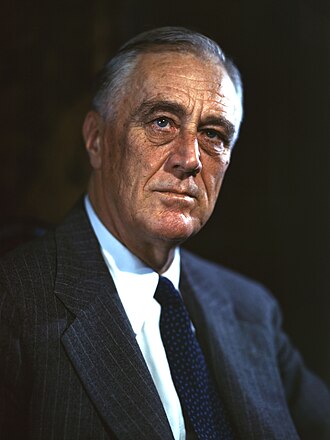
President 32 of 47
Franklin D. Roosevelt
1933–1945 · Democratic · New York
He led through the Depression and World War II — the only president elected four times.
- Lived
- 1882–1945
- Vice president
- John Nance Garner; Henry Wallace; Harry Truman
- Nickname
- FDR
- Home state
- New York
“The only thing we have to fear is fear itself.”
The story
Franklin D. Roosevelt served as president from 1933–1945. He was a Democratic president from New York — and a distant cousin of Republican Theodore Roosevelt. He had been governor of New York before 1933. Polio left him unable to walk without help; he used braces, a wheelchair, and careful staging so the public often saw him standing. He is the only president elected more than twice: four times, in 1932, 1936, 1940, and 1944. The 22nd Amendment, passed after FDR, says a president may be elected twice.
His program to fight the Depression was called the New Deal: jobs programs, new rules for banks, and a much bigger federal government. Social Security, which pays retirement benefits, began in 1935. His radio talks to families were called fireside chats — he sounded like a neighbor in the living room. The “Hundred Days” was a burst of emergency laws at the start of his presidency. Frances Perkins, secretary of labor, was the first woman to serve in a president's Cabinet. A fair statement about the New Deal: it grew the federal government, but unemployment stayed high until the war.
Japan attacked Pearl Harbor on December 7, 1941. FDR called it “a date which will live in infamy.” After Pearl Harbor, his main job became leading the country in World War II. The Lend-Lease Act armed Allied countries before the U.S. fully entered the war. During World War II, Roosevelt's government moved many Japanese Americans to inland camps away from the West Coast. He died in 1945 before the final victory in World War II. Harry Truman finished the war.
Why it matters
He led America through two of the hardest tests in its history: a depression and a world war. You cannot understand today's government without the New Deal and World War II.
Check for understanding
20 questions from the lesson above. Misses come with a short explanation — then the lesson is yours.
Question 1 of 20
0 correct