
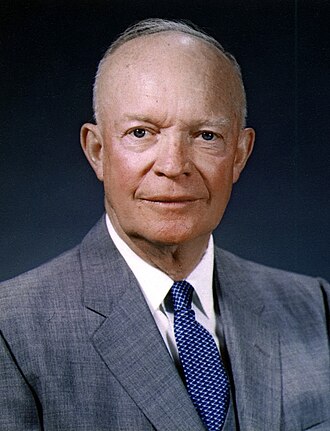
President 34 of 47
Dwight D. Eisenhower
1953–1961 · Republican · Kansas
The general who helped win World War II built interstates and warned about a “military-industrial complex.”
- Lived
- 1890–1969
- Vice president
- Richard Nixon
- Nickname
- Ike
- Home state
- Kansas
“Plans are worthless, but planning is everything.”
The story
Everyone called Dwight D. Eisenhower Ike. Campaign buttons even sang “I Like Ike.” He was a Republican, born in Texas and raised in Abilene, Kansas — Kansas is the state he claimed. Before the White House he was the Allied commander of D-Day in World War II. On June 6, 1944, he led the landing in Normandy that helped free Europe from Nazi Germany. He served two full terms as president, from 1953 to 1961. His vice president was Richard Nixon.
Ike's style was to keep the peace, build the country, and avoid new wars. He helped end the Korean War; an armistice in 1953 stopped the fighting after he had promised to go to Korea and work for peace. He is especially tied to the Interstate Highway System. The 1956 highway law stitched the country together with roads for travel, trade, and defense. Ike had seen Germany's autobahn. He wanted American roads that could move troops and supplies fast if the country were attacked.
In 1957 the Soviets launched Sputnik, the first man-made satellite. It beeped over American skies. Congress answered by creating NASA in 1958. After Sputnik, Eisenhower also signed the National Defense Education Act to pour money into science, math, and language study. Alaska became the 49th state in January 1959 and Hawaii the 50th that August. In 1957 he sent U.S. troops to Little Rock, Arkansas, so a court order — not a mob — would decide, and Black students could enter Central High. The U-2 crisis of 1960 involved an American spy plane shot down over the Soviet Union. In his farewell address he warned Americans about the military-industrial complex: he wanted a strong defense, and a country that did not let weapons businesses run the government. He did not land Americans on the Moon; he built NASA and set the stage.
Why it matters
He connected the nation with roads, ended the fighting in Korea, and kept the Cold War from becoming World War III. Farewell addresses can matter as much as inaugural ones.
Check for understanding
20 questions from the lesson above. Misses come with a short explanation — then the lesson is yours.
Question 1 of 20
0 correct