
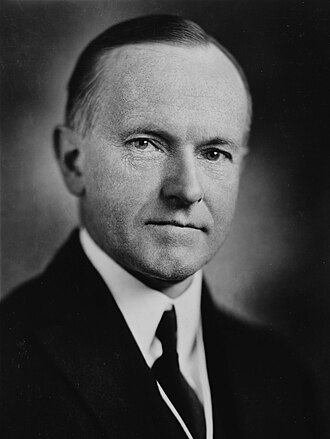
President 30 of 47
Calvin Coolidge
1923–1929 · Republican · Massachusetts
A famously quiet president who let the Roaring Twenties roar.
- Lived
- 1872–1933
- Vice president
- None; Charles G. Dawes
- Nickname
- Silent Cal
- Home state
- Massachusetts
“The chief business of the American people is business.”
The story
Calvin Coolidge served as president from 1923–1929. He finished Harding's term and won in 1924, serving until 1929. He was a Republican from Massachusetts. His nickname was Silent Cal — he said little and meant it. When Harding died, Coolidge was vacationing at the family farm in Vermont. His father, a notary, in a Vermont farmhouse swore him in by kerosene lamp. It is one of the most famous scenes in presidential history.
Coolidge told newspaper editors that the chief business of the American people is business. He meant a country busy making, selling, and building — not a government running everything. His tax policy was to cut taxes. He and Treasury secretary Andrew Mellon cut tax rates while the 1920s economy boomed. The 1920s under Coolidge are remembered as a time of boom and prosperity for much of the country. Factories hummed, radios spread, and many Americans felt flush. He is often held up as a model of limited government and prosperity.
After Harding's scandals, Coolidge restored trust by firing the worst actors. In 1924 he won a landslide. He was the first president whose inauguration was broadcast on radio, in 1925. He signed the Indian Citizenship Act of 1924, which made Native Americans U.S. citizens. The Kellogg–Briand Pact of 1928 claimed to outlaw war on paper. In 1928 he chose not to run. He left office still popular. The stock-market crash of 1929 happened months after he had already left — Hoover, not Coolidge, was president when it hit.
Why it matters
He showed that a small, quiet government can match a booming country. Tax cuts, a boom, and self-restraint: not every problem is a job for the White House.
Check for understanding
20 questions from the lesson above. Misses come with a short explanation — then the lesson is yours.
Question 1 of 20
0 correct